
On a Tuesday morning in Lagos, Amaka opened her phone and checked her website statistics.
The numbers looked encouraging.
Hundreds of people had visited her sales page over the previous few days.
People were clicking her product images.
They were reading the offer.
Some were even reaching the pricing section.
But the number of completed orders was disappointing.
Very disappointing.
Amaka sold a digital training programme for small business owners. She had invested money in Facebook and Instagram advertising, spent hours creating content, and had finally built a sales page that looked professional.
So why weren’t more people buying?
She initially assumed the problem was the price.
Then she assumed people weren’t interested.
Then she blamed the economy.
But when she looked more closely at what visitors were doing, she discovered something important.
Many visitors weren’t rejecting the offer. They were simply leaving before making a decision.
And once they left, most of them were gone.
There was no email address.
No WhatsApp conversation.
No phone number.
No way to remind them about the offer.
The advertising money that brought those visitors to the website had already been spent.
But the potential customers had disappeared.
The Hidden Cost of Website Visitors Who Leave
This is a common problem for online businesses.
You pay for traffic.
A visitor lands on your page.
They browse.
They become interested.
Something makes them hesitate.
And they close the browser.
From your analytics dashboard, that may simply appear as another visitor who didn’t convert.
But from a sales perspective, that visitor may have been much more valuable.
They could have been:
- Someone comparing your offer with another one
- Someone who wanted to ask a question before buying
- Someone waiting for payday
- Someone who needed to discuss the purchase with a partner
- Someone who wasn’t ready at that exact moment
- Someone who simply got distracted
The mistake is assuming that “didn’t buy” means “wasn’t interested.”
Sometimes it simply means “not yet.”
Amaka Changed One Thing
Instead of allowing every undecided visitor to disappear, Amaka introduced a simple last-chance conversion opportunity.
When a visitor showed signs that they were about to leave the page, the website presented a message.
Not an aggressive popup screaming:
BUY NOW!!!
Instead, it offered another way to continue the conversation.
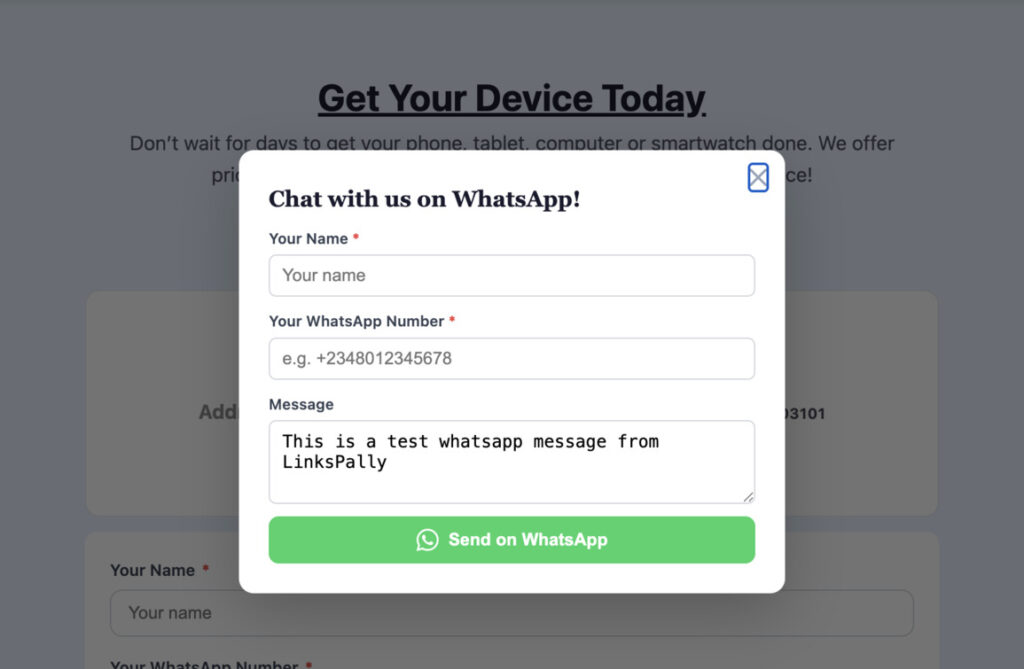
Visitors could provide their contact details or initiate a WhatsApp conversation.
That small change completely altered what happened to some of her abandoning visitors.
Instead of:
Ad → Website → Leave → Lost
she now had:
Ad → Website → Consider → About to Leave → Lead/WhatsApp Conversation
The visitor didn’t necessarily have to buy immediately.
The business simply needed permission to continue the relationship.
This Is Where Exit-Intent Lead Capture Becomes Powerful
An exit-intent system detects when a visitor appears to be leaving a page and gives the business one final opportunity to engage them.
The purpose isn’t necessarily to force a sale.
It can be used to:
- Capture an email address
- Start a WhatsApp conversation
- Offer additional information
- Provide a special offer
- Answer a common objection
- Invite the visitor to a webinar
- Encourage the visitor to return later
- Give the visitor another reason to continue
For businesses running paid advertising, this can be especially important.
You’ve already paid to get the visitor.
It makes sense to make another attempt to capture value from that visit.
How LinksPally Can Help
This is one of the conversion features built into LinksPally.
Instead of needing a separate popup plugin, another lead-generation system and another WhatsApp integration, LinksPally can use its exit-intent functionality on a Link-in-Bio or conversion-focused page.
The popup can be configured around the action you want the visitor to take.
For example:
“Not ready to buy yet? Get the details on WhatsApp.”
Or:
“Have a question before ordering? Chat with us.”
Or:
“Want to receive the full guide before making a decision?”
The visitor can then be directed into the appropriate lead-capture process.
And because LinksPally’s lead-generation features can connect with the broader marketing workflow, that captured prospect doesn’t have to remain a random WhatsApp conversation or an isolated form submission.
The lead can become part of the business’s follow-up process.
The Important Difference: You’re Not Trying to Save Every Visitor
This is where many businesses get exit-intent marketing wrong.
The goal isn’t to stop every visitor from leaving.
Some visitors will leave.
Some aren’t interested.
Some aren’t qualified.
That’s normal.
The objective is to identify visitors who may still have commercial value and give them a useful alternative before they disappear.
For example, imagine 1,000 people visit a sales page.
Suppose only 30 buy immediately.
It would be a mistake to think the other 970 people were worthless.
Some may never buy.
But some could become customers tomorrow, next week or next month.
The question becomes:
How many of those potentially valuable visitors can you turn into identifiable leads?
That’s a much better question than simply asking how many visitors left.
What Happened to Amaka’s Business?
Amaka didn’t suddenly turn every abandoning visitor into a customer.
That wasn’t realistic.
What changed was that she stopped treating every non-buyer as a permanently lost customer.
Some visitors started contacting her on WhatsApp.
Some left their details.
Some asked questions.
Some eventually purchased.
And perhaps most importantly, she began building an audience of people who had already demonstrated interest in her offer.
Her advertising was no longer producing only immediate sales.
It was also producing future sales opportunities.
That’s a significant difference.
Your Website Traffic Is More Valuable Than Your Conversion Report Suggests
If you’re running Facebook, Instagram, Google or TikTok campaigns, it’s easy to focus exclusively on immediate conversions.
But the customer journey isn’t always:
Click → Buy.
It can be:
Click → Read → Think → Leave → Ask Question → Follow Up → Buy.
A good marketing system should account for that journey.
That’s why lead capture, WhatsApp conversations, email follow-up and retargeting are so important.
Your first job isn’t always to close the sale.
Sometimes your first job is simply to avoid losing the relationship.
5 Questions to Ask About Your Sales Page
If you’re currently sending traffic to a WordPress sales page, ask yourself:
1. What happens when someone is about to leave?
Do they simply disappear?
2. Can visitors contact you without searching for your phone number?
For many Nigerian customers, WhatsApp can be a much easier next step than filling a long form.
3. Can you capture people who aren’t ready to buy?
If not, you’re potentially paying repeatedly to reacquire the same prospects.
4. Do you have a follow-up system?
Capturing a lead without following up solves only half the problem.
5. Are you measuring the journey beyond the final purchase?
Clicks, leads, conversations and engagement can all provide useful signals.
The Bigger Lesson
Amaka’s problem wasn’t that she had no traffic.
She had traffic.
Her problem wasn’t even necessarily that her product was bad.
The bigger problem was that her website treated every visitor who didn’t buy immediately as if the relationship had ended.
Once she created another opportunity for those visitors to engage, her marketing funnel became more resilient.
That’s the real value of exit-intent lead capture.
It gives interested visitors another path instead of allowing them to disappear.
And for businesses spending money to acquire website traffic, that can make a significant difference.
If you’re using WordPress and want to build pages that don’t just display links but also capture leads, start WhatsApp conversations, nurture prospects and turn traffic into measurable opportunities, LinksPally is designed for exactly that kind of workflow.
The question isn’t only:
“How many people visited my website?”
A better question is:
“How many potential customers did I save before they walked away?”
Frequently Asked Questions
What is exit-intent lead capture?
Exit-intent lead capture is a marketing technique that presents a visitor with a relevant call-to-action when they show signs of leaving a webpage. The goal is to capture the visitor as a lead or encourage another useful action before they leave.
Can exit-intent popups capture WhatsApp leads?
Yes. An exit-intent campaign can be designed to encourage visitors to start a WhatsApp conversation instead of simply leaving the website.
Is exit-intent useful for Nigerian businesses?
Yes. It can be particularly useful for businesses that acquire visitors through social media advertising and prefer conversational sales through channels such as WhatsApp.
Does every website visitor need to see an exit popup?
No. Exit-intent campaigns should be used strategically. The message should provide a useful next step rather than simply interrupting the visitor.
Can LinksPally capture leads from a WordPress page?
Yes. LinksPally includes lead-capture functionality alongside its Link-in-Bio, WhatsApp, email automation, payment, webinar and tracking capabilities.
Can captured leads be followed up later?
Yes. LinksPally’s lead-generation functionality can be connected to its broader email and WhatsApp marketing workflows, allowing businesses to nurture prospects rather than relying only on immediate purchases.