
Imagine a Lagos business owner spending ₦150,000 on promotional flyers for a new product.
The flyer contains a QR code and a short web address leading customers to the product page.
The campaign starts well.
Then something changes.
The product page is redesigned. The price changes. The business moves the offer to another page. Perhaps the company launches a limited-time discount and wants everyone clicking the old promotional link to see the new offer instead.
The problem?
Thousands of flyers have already been distributed.
The link is printed on banners.
It has been posted on Instagram.
Customers have shared it on WhatsApp.
An influencer has included it in a video description.
A sales representative has sent it to hundreds of prospects.
The business cannot realistically go back and change all those links.
This is one of the overlooked problems with digital marketing: a marketing link can remain in circulation long after the page it points to has changed.
For Nigerian businesses running advertising campaigns, promotions, events, ecommerce stores, lead-generation campaigns and offline marketing, having control over promotional links can prevent unnecessary traffic loss and wasted marketing materials.
This is where a redirect management system such as LinksPally can become useful.
The real problem is not the URL. It is losing control of the traffic.
Many business owners think of a URL as simply an address.
For example:
yourbusiness.com/product
But in marketing, a URL can become much more valuable than that.
It can appear on:
- Printed flyers
- Business cards
- Billboards
- Posters
- Radio advertising
- Social media posts
- WhatsApp messages
- Email campaigns
- Google Ads
- Facebook and Instagram Ads
- Influencer campaigns
- YouTube descriptions
- QR codes
- Blog posts
- Affiliate promotions
Once that address is distributed, the business no longer controls where every copy of it appears.
This creates a problem when the destination changes.
Suppose a Nigerian fashion business prints:
yourbrand.com/asoebi
on 20,000 promotional flyers.
Three months later, the business decides that the campaign should now promote a new collection.
The flyers are already outside the company’s control.
The URL, however, can still be controlled.
Instead of treating the printed address as the final destination, the business can treat it as a permanent entry point that can be redirected whenever necessary.
That small distinction can make a major difference.
A practical Nigerian business example
Consider a fictional Lagos-based business called Adunni Fashion House.
The company is preparing for the December shopping season.
Its marketing team creates a landing page for a new collection:
adunnifashion.com/december
The marketing team then uses the URL across several channels.
Offline campaign
The URL is printed on 10,000 flyers.
WhatsApp campaign
The sales team sends the URL to previous customers.
Social media
The link is published on Instagram and Facebook.
Influencer campaign
Two fashion influencers include the URL in their promotional content.
Paid advertising
The marketing team uses the same address in a campaign.
Everything works.
Until the company changes its promotion.
After two weeks, the business decides to move customers to a new landing page offering:
Buy 2 outfits and get free delivery.
The new page is:
adunnifashion.com/free-delivery
The marketing team now has two choices.
Option 1: Try to replace every old link
This is practically impossible.
The flyers are already distributed.
The Instagram post cannot be rewritten in every customer’s WhatsApp chat.
The influencers have already published their content.
Customers may have bookmarked or shared the original address.
The old URL could continue circulating for months.
Option 2: Redirect the old URL
The company keeps:
adunnifashion.com/december
but changes where visitors are sent.
Now anyone visiting the old promotional address can be sent to:
adunnifashion.com/free-delivery
The printed flyer does not need to change.
The WhatsApp message does not need to be resent.
The influencer does not necessarily need to publish a new video.
The old marketing asset continues to have value.
Why this matters particularly for Nigerian businesses
This problem is not unique to Nigeria.
But there are several reasons why link flexibility can be particularly useful for businesses operating in the Nigerian market.
Nigerian businesses frequently combine online and offline marketing.
A business may advertise a promotion through:
- roadside banners
- printed flyers
- radio
- events
- physical stores
- sales agents
- church or community networks
- customer referrals
Once a promotional URL enters these different channels, changing the destination manually becomes difficult.
A redirect provides a bridge between the old marketing asset and the new business objective.
Example: A Nigerian restaurant changes its menu
Consider a restaurant in Lagos promoting a special Valentine’s package.
The restaurant prints:
restaurant.com/valentine
on posters and flyers.
The campaign ends.
If the restaurant leaves the page untouched, customers arriving later may see an expired offer.
That creates a poor customer experience.
Worse, the business may have spent money getting people to that URL through advertising.
Instead of allowing the old link to become useless, the restaurant could redirect visitors to:
restaurant.com/menu
or a new seasonal offer.
The original marketing material remains useful.
This is particularly valuable for URLs distributed through channels that cannot easily be updated.
Example: An event company changes its registration page
Imagine an event company promoting a business conference in Lagos.
The promotional URL is printed on banners:
eventcompany.ng/conference
After the venue changes, the company creates a new registration page.
The old URL has already been shared extensively.
Without redirect management, visitors may encounter outdated information.
With a redirect, the company can send visitors from the old promotional URL to the new registration page.
The important point is that the marketing address does not have to change just because the destination changes.
Example: An ecommerce business replaces a product page
This can be even more important for Nigerian ecommerce businesses.
Suppose an online store promotes:
store.ng/blender
The product becomes unavailable.
The store has already shared the URL through:
- Facebook posts
- Google Ads
- affiliate websites
- blog articles
Deleting the page can create a dead end.
But sending every visitor to the homepage is not always ideal either.
The business might instead redirect visitors to:
- a replacement product
- a similar product category
- a current promotion
- a product comparison page
The goal is to preserve the visitor journey.
Why simply changing the website page may not solve the problem
A common misunderstanding is:
“If I change the page on my website, customers will automatically see the new information.”
That depends on how the URL is being used.
If you completely replace the content at the same URL, the situation may be straightforward.
But businesses often need to move an offer to another URL because:
- the page structure changed
- a product was discontinued
- a promotion ended
- a campaign has been replaced
- a new landing page was created
- the business changed its website structure
- an event registration page closed
- a different sales funnel is now being used
In those situations, having a controlled redirect can be much more practical.
The bigger problem: marketing links can outlive campaigns
This is where many small businesses underestimate the problem.
A campaign might officially last 14 days.
But its links can survive for years.
A customer may have:
- saved the URL
- bookmarked it
- forwarded it
- posted it in a WhatsApp group
- included it in a blog post
- shared it with a friend
- taken a screenshot of the flyer
- scanned the QR code months later
The campaign may be finished, but the URL can continue receiving visitors.
That means a marketing team should think about link lifecycle management, not just campaign creation.
How LinksPally fits into this workflow
LinksPally is a WordPress-based marketing link management tool.
For businesses already running their websites on WordPress, the useful idea is relatively simple:
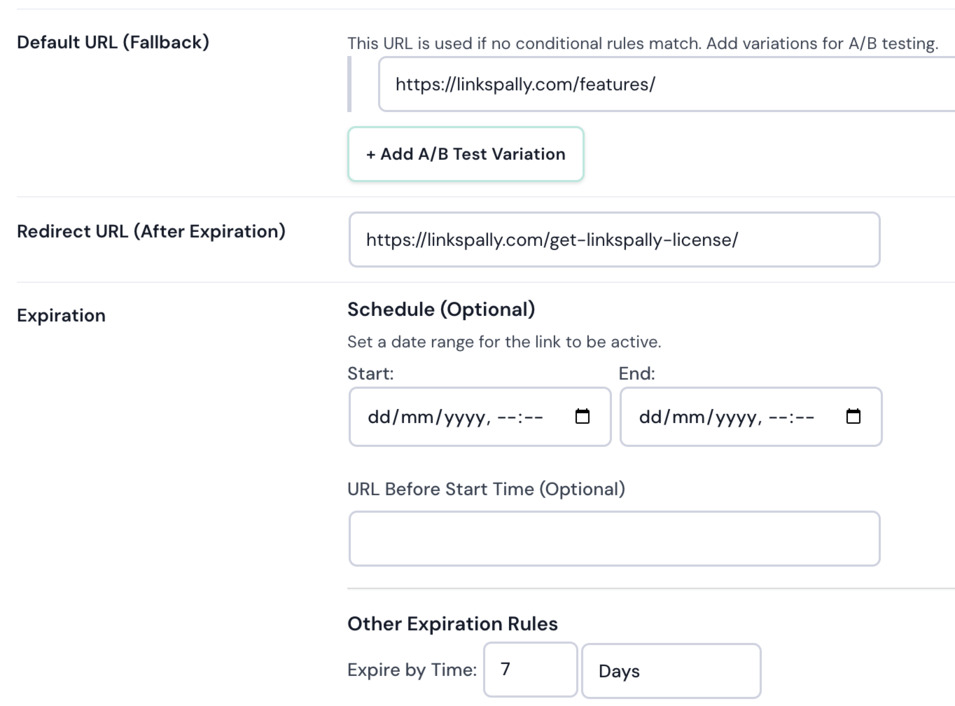
Create a controlled marketing URL and determine where visitors should be sent.
If the business later changes the destination, it can update the redirect rather than having to replace every published copy of the marketing URL.
The underlying LinksPally redirect implementation uses WordPress’s redirect mechanism to send qualifying requests to a configured destination. Its code also contains protection against redirecting a URL back to itself, which helps prevent a simple redirect loop.
The advantage is less about having another complicated marketing technology and more about gaining control over URLs that have already been distributed.
A simple workflow for Nigerian businesses
A practical workflow could look like this:
Step 1: Create a stable marketing URL
Instead of putting a long product URL everywhere, create a memorable campaign address.
For example:
yourbusiness.com/offer
Step 2: Distribute that URL
Use it on:
- flyers
- social media
- ads
- QR codes
- banners
Step 3: Send visitors to the current campaign page
Initially:
/offer → /january-promotion
Step 4: Change the destination when the campaign changes
Later:
/offer → /february-promotion
The marketing materials containing /offer do not need to be redesigned.
Step 5: Keep the stable URL useful
The same approach can continue throughout the life of the campaign or marketing asset.
This turns the URL into a controllable marketing asset rather than a disposable address.
What about links already shared on WhatsApp?
This is one of the most practical scenarios.
Imagine a Nigerian business has sent a promotional link to 5,000 customers over several months.
Those customers may have forwarded the message.
Some may have saved it.
Some may have bookmarked the page.
If the business changes the destination URL itself, those old messages still contain the original address.
A redirect allows the business to maintain control over that address.
For example:
Old shared link
brand.ng/promo
Current destination
brand.ng/new-offer
Someone clicking the old WhatsApp message can still reach the current offer.
That is considerably easier than asking thousands of customers to search for the new link.
What about printed flyers?
This is perhaps one of the clearest use cases.
Printed advertising has one major weakness compared with digital advertising:
It cannot be edited after distribution.
Once 20,000 flyers have been printed, changing the URL requires a new print run.
The same applies to:
- posters
- banners
- stickers
- packaging
- brochures
- business cards
- event programmes
A controlled redirect can make the destination flexible even though the printed URL remains unchanged.
This does not mean every printed URL should automatically redirect forever.
It means the business has an option to change the destination when circumstances change.
QR codes make this even more important
QR codes are increasingly used to connect physical marketing to websites.
But there is a hidden issue.
Once a QR code has been printed, the encoded destination cannot normally be changed by editing the piece of paper.
For example:
A restaurant prints a QR code on 5,000 table cards.
The QR code points to:
restaurant.ng/menu
Later, the restaurant creates a new menu page.
If the QR code directly encodes the old destination, changing the website structure can create problems.
A more flexible approach is to have the QR code point to a controlled URL such as:
restaurant.ng/menu
and allow the controlled URL to redirect to the current destination.
The physical QR code remains the same while the destination can change.
This is also useful for agencies managing multiple campaigns
Digital marketing agencies face another version of the problem.
An agency may manage campaigns for several Nigerian businesses.
Each campaign can have multiple links.
Without a structured system, campaign URLs can become difficult to manage.
An agency might have:
- Client A’s Facebook campaign
- Client A’s WhatsApp campaign
- Client B’s Google campaign
- Client B’s influencer campaign
- Client C’s event campaign
- Client C’s offline flyer campaign
A redirect management workflow can make it easier to maintain these destinations without repeatedly changing published campaign materials.
The important principle is:
Separate the public marketing address from the destination page.
That gives the marketer more flexibility.
What if the campaign is completely finished?
A redirect is not an excuse to keep sending visitors to an irrelevant promotion.
If an offer has ended, the business should decide what the visitor should see next.
Depending on the situation, the old URL could point to:
- the company’s main offer
- a replacement promotion
- the relevant product category
- a registration page
- the business homepage
- a waitlist
- a new event
- a customer support page
The best destination depends on the original visitor intent.
For example, someone clicking a flyer for a discontinued phone should probably not be sent to a generic homepage.
A replacement phone or smartphone category would usually provide a more useful experience.
Redirects are not only about convenience
There is a financial consideration.
Suppose a company spends ₦300,000 promoting an offer through digital and offline channels.
The company later changes the landing page.
If old campaign URLs stop working, some of that previous marketing investment can become less useful.
A controlled redirect gives the company an opportunity to continue benefiting from traffic generated by previously distributed links.
The value is therefore not simply:
“I don’t have to change my URL.”
It is:
“Traffic generated by previous marketing efforts can continue reaching a relevant destination even after the campaign structure changes.”
That is a much more important business benefit.
A useful way to think about marketing URLs
Instead of thinking:
URL = webpage address
think:
Marketing URL = controlled entrance to a customer journey
The webpage behind the entrance can change.
The entrance can remain the same.
That model is particularly useful when the URL has already been distributed widely.
When should a Nigerian business use a controlled redirect?
You should consider this approach when a URL is likely to be distributed widely or used for an extended period.
Good examples include:
Promotional campaigns
A business may change offers regularly.
Printed marketing
Flyers and banners cannot be edited after distribution.
QR codes
The printed QR code may need to remain useful even when the destination changes.
WhatsApp marketing
Previously shared messages can continue generating clicks.
Influencer campaigns
Published videos and posts can remain online for months or years.
Paid advertising
Campaign destinations may change during optimisation.
Events
Registration pages can become outdated after an event.
Product marketing
Products may become unavailable or be replaced.
Affiliate marketing
Third parties may continue using previously supplied links.
What LinksPally does not replace
A redirect system is not a substitute for good website management.
Businesses should still:
- maintain accurate website content
- monitor important pages
- use appropriate redirects when URLs change
- update outdated campaigns
- remove expired offers where appropriate
- maintain good SEO practices
- test important links
- monitor campaign performance
The goal is not to hide poor website maintenance.
The goal is to make marketing URLs easier to manage when the destination needs to change.
A better link strategy for Nigerian businesses
For businesses running regular marketing campaigns, a simple system can make link management much easier.
Instead of creating disposable links for every campaign, identify important marketing URLs that are likely to be reused.
For example:
Marketing purpose | Stable URL | Current destination |
|---|---|---|
Main promotion |
| Current promotion |
WhatsApp campaign |
| WhatsApp sales page |
Product campaign |
| Current product page |
Event |
| Current registration page |
Flyer |
| Current flyer offer |
Discount |
| Current discount page |
The stable URL becomes the asset.
The destination can change as the business changes.
The key lesson from this problem
Marketing campaigns change.
Products change.
Prices change.
Landing pages change.
Websites are redesigned.
Events end.
Promotions expire.
But links that have already been distributed do not automatically disappear.
That is why businesses should think carefully about which URLs they publish publicly.
For important marketing campaigns, using a controllable redirect can provide an additional layer of flexibility.
And for a WordPress-based business, LinksPally provides one way to manage this kind of redirect workflow without requiring the marketing team to rebuild every flyer, WhatsApp message, social post or campaign asset whenever the destination changes.
The important part is not the software itself.
The important part is the strategy:
Create marketing links you can continue to control even when your campaigns change.
That can help Nigerian businesses get more useful life out of their advertising materials, maintain better customer journeys and avoid turning previously distributed links into dead ends.
Frequently Asked Questions
Can I change where a marketing link sends visitors without changing the link itself?
Yes. A controlled redirect allows the public URL to remain the same while the destination URL is changed.
Can this work with links already printed on flyers?
Yes, provided the printed URL points to a redirect you control. The flyer itself does not need to be reprinted when you change the destination.
Can businesses use redirects for WhatsApp marketing?
Yes. A business can distribute a controlled URL through WhatsApp and later change its destination without requiring everyone who received the original message to receive a new URL.
Are redirects useful for QR codes?
Yes. A QR code can point to a controlled URL. The destination behind that URL can then be changed without changing the physical QR code.
Can ecommerce businesses use marketing redirects?
Yes. They can be useful when products are discontinued, landing pages change, promotions expire or customers need to be sent to a replacement product or category.
Is LinksPally only useful for large companies?
No. A small Nigerian business running campaigns through WhatsApp, Instagram, flyers, Google Ads or a WordPress website can benefit from having better control over important marketing URLs.
Does using a redirect mean I should never change my website URLs?
No. Website architecture and SEO should still be managed properly. Redirects are particularly useful when an existing URL has already been distributed and the business needs visitors to reach a new destination.
Final takeaway
If your Nigerian business has ever printed a flyer, published a promotional post, sent a WhatsApp campaign or launched an advertisement and later thought:
“We need to change where this link goes, but the old link is already everywhere.”
you have encountered the problem that controlled marketing redirects are designed to solve.
The smarter approach is to make the marketing URL stable while keeping the destination flexible.
That way, when your campaign changes, your links do not necessarily have to.